
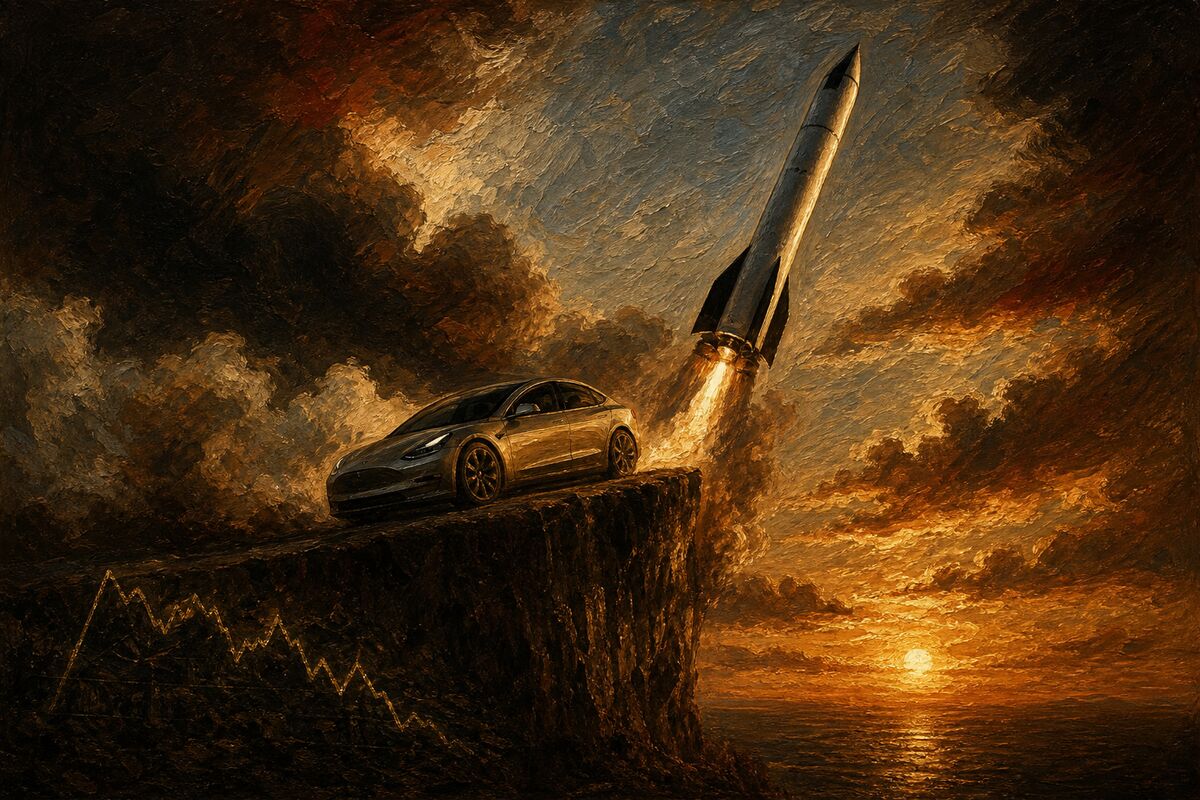
Tesla and SpaceX have placed a fresh question mark over the market: What would happen if one of the world’s most closely watched electric-vehicle companies began exploring a combination with Elon Musk’s space venture? According to the Seeking Alpha news wire, Musk stated that SpaceX and Tesla have formed committees to explore a potential merger.
That sentence is powerful enough to rattle screens, but it is not a transaction announcement. Committees exploring a possible merger are an early-stage development, not a completed deal, signed agreement, or disclosure of terms. For holders of $TSLA, that distinction is the line between a headline and an investable set of facts.
A headline with a long financial shadow
Tesla’s stock has a particularly large audience beyond individual shareholders. The company’s relevance to major U.S. indexes, including the S&P 500 and Nasdaq-100, means a major corporate-development headline could draw attention well beyond the electric-vehicle trade. Even before investors know the proposed structure, the story may become a focal point for market participants tracking index exposure, technology shares and the broader appetite for high-profile growth companies.
That is why the committee announcement could produce significant headline-driven volatility in $TSLA. The market has a habit of trying to price the ending of a story before the first chapter is finished. Traders may react to the possibility of a merger, while longer-term shareholders may focus on questions that the current report does not answer: What would the transaction involve? How would the businesses be combined? What approvals might be required? And what would the arrangement mean for Tesla’s existing shareholders?
At this stage, those questions remain open. The reported development provides no deal terms or valuation, and it does not establish that a merger will occur. Any market reaction that treats exploration as certainty risks getting ahead of the facts.
Why TSLA shareholders are watching closely
For Tesla investors, the potential significance lies not only in the identity of the other company but also in the possibility of a major change to the corporate story. Tesla is widely followed as an electric-vehicle and technology company. SpaceX represents a different part of Musk’s business orbit, with a focus on space. A potential combination could therefore invite debate about strategy, capital allocation, governance and the boundaries of Tesla’s existing identity.
But those are areas for analysis, not conclusions. Without reported deal terms, investors cannot responsibly assign a value to the proposal or determine how it would affect Tesla shareholders. The formation of committees indicates that discussions are being explored; it does not indicate that a definitive agreement exists.
Read-through for EV and space sectors
The news may also cast a wider spotlight on both the electric-vehicle and space sectors. Tesla’s name could pull EV-sector attention toward corporate structure and competitive positioning, while SpaceX’s involvement could broaden investor discussion around the commercial space industry. Still, any sector read-through remains conditional on what the committees discover and whether the exploration advances.
The immediate market story, then, is less about a finished merger than about uncertainty acquiring a very recognizable name. For $TSLA shareholders, the next meaningful signal may be additional detail—not louder speculation. Until then, the committees are a development to monitor, not evidence of a completed transaction.
Bull/Bear Verdict
Bull Case: The formation of committees could keep attention on Tesla and create a potentially important strategic conversation spanning the EV and space sectors, while further details may clarify the opportunity for $TSLA shareholders.
Bear Case: The report describes only an exploration of a potential merger, with no definitive agreement, deal terms or valuation disclosed; that uncertainty could leave $TSLA exposed to sharp headline-driven volatility.